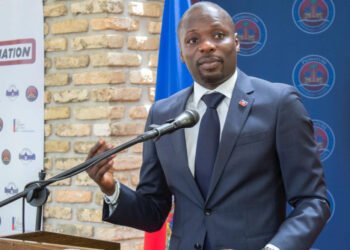



A guest on the show Ayisyen m ye, hosted by Mathias Pierre on Radio Télévision Caraïbes, Sandra Paulemon delivered a dense, thoughtful, and uncompromising testimony regarding her civic engagement, her personal journey, and her vision of the role that youth and the diaspora must play in transforming Haitian society. Far from the usual clichés and political posturing, her intervention stood out as an exercise in clarity, supported by an academic, professional, and human trajectory built over time.
An entrepreneur, communicator, analyst, and a doctoral candidate in the final stages of her degree in Public Policy with a concentration in Social Policy, Sandra Paulemon holds a bachelor’s degree in Communication Sciences, an MBA in Finance, and a master’s degree in International Relations and Affairs. This multidisciplinary background sheds light on an approach to engagement based on understanding institutions, power dynamics, and social forces—going far beyond the simple conquest of political positions.
A former candidate for deputy for the Cornillon/Grand-Bois constituency, she never separates politics from the notion of service. On the set of RTVC Haïti, she explained that her commitment stems neither from improvisation nor opportunism, but from a progressive construction fueled by experience, observation, and work on the ground.
Sandra Paulemon does not define herself as a classic politician, but as a woman engaged by conviction. Born in Port-au-Prince and raised in Cornillon Grand-Bois, she claims an identity deeply anchored in popular realities. She comes from a family already involved in public life: her father, Jean-Baptiste Paulemon, was a former public notary and communal magistrate during the Duvalier era, and her mother was a seamstress and a Lavalas militant. “I didn’t enter politics by chance. I grew up in it,” she asserts.
Reacting to this introduction, host Mathias Pierre pointed out that she comes from two political poles often perceived as opposed, or even extreme. It is an observation that Sandra Paulemon fully accepts. She answered without hesitation: “Mwen sòti nan de pôle politik ki chak gen yon jan yo wè Ayiti, epi chak gen yon jan pa yo, yo renmen Ayiti” (I come from two political poles that each have their own way of seeing Haiti, and each has their own way of loving Haiti). This response summarizes her stance: refusing simplistic divides and recognizing the plurality of visions, while affirming a common attachment to the country.
For her, this duality is neither a contradiction nor a handicap, but an asset. She sees in it the possibility of understanding Haiti in its complexity, without reducing love for the country to a single ideological reading. One can love Haiti differently without necessarily being enemies.
A decisive turning point in her journey occurred at the age of 26. While living in the United States, in Connecticut, enjoying a stable and comfortable lifestyle, she made a decision that many would judge irrational: returning to Haiti to engage directly in the political field. This choice, which she fully stands by, was inspired by the example of her father, who himself returned to live in his country after spending time abroad. She explains that she understood that real impact is built where the needs are most urgent.
This immersion in Haiti, far from being idealized, was marked by strong political and social turbulence. Sandra Paulemon speaks of a formative period—sometimes grueling—that helped forge her personality and refine her view of citizenship. According to her, those years primarily allowed her to measure the extent of the deficit in civic education and legal knowledge within Haitian society, a realization she deems fundamental to understanding the fragility of the bond between citizens and institutions.
She believes that one cannot demand a functional democracy without citizens who are informed of their rights and duties. For her, the absence of a civic culture fuels political manipulation, citizen demobilization, and the reproduction of governance practices that are disconnected from social realities.
Her engagement also falls within an assumed ideological dimension. She identifies with the values carried by the Pitit Dessalines party, which she perceives as an attempt to reconnect with the ideals of Jean-Jacques Dessalines: sovereignty, social justice, and national dignity. She maintains that these ideals remain a relevant compass for thinking about the country’s future, while recalling that ideology can never replace critical analysis or concrete action.
The massive popular mobilizations of 2015 constituted another structural moment in her journey. The street, the confrontation, and sometimes the violence became an open-air political school. “I didn’t enter politics to make a living from it, but to work,” she insists. This period, rather than driving her away, reinforced her conviction that real change requires endurance, rigor, and consistency.
With her partner Assad Volcy, she then began a transition into journalism by co-founding Gazette Haïti News in May 2017. The media outlet was born from the meeting of two different but complementary temperaments, driven by the same vision: to inform with rigor, contribute to civic education, and defend citizen rights. She specifies that it was not a “clan” media outlet, but a tool at the service of society, claiming an assumed editorial independence in an often polarized media landscape.
This coherence between words and action is also evident in her recent choices. In 2024, when the post of Deputy Director of the ONA (National Old-Age Insurance Office) was offered to her by the Transitional Presidential Council, she declined the offer. A refusal that surprised many, but which she justifies straightforwardly. She explains that titles do not interest her if they produce no real impact on the lives of citizens.
Ten years after her first commitments, Sandra Paulemon states she has no regrets. Every step, including failures and sacrifices, has helped strengthen her stance and refine her vision. Today, she claims a multiform engagement—academic, entrepreneurial, media-related, and civic—convinced that social transformation does not happen through a single channel.
At the end of the broadcast, her message to the youth and the diaspora was clear, almost demanding. Engage, yes, but without seeking recognition or obsessing over positions. “My only true regret would be to betray what I believe in,” she affirms. For her, returning to Haiti must never be an individual or narcissistic project. It is about coming to learn, listen, and understand the realities on the ground, not to impose ready-made solutions.
She insists on the importance of local actions, often modest but essential. Haiti, she argues, needs responsible citizens convinced that every small action can yield great results. It is a call for humility and consistency, in a context where grandiloquent speeches have too often replaced action.
Through her testimony, Sandra Paulemon embodies another way of conceiving political engagement: simpler, more coherent, anchored in the ethics of service rather than the pursuit of power. In a country marked by deep mistrust toward its elites, her path serves as a reminder that engagement can still be an act of courage, responsibility, and faith in the collective.
Soutenez Hebdo24 : pour une information libre et fiable.
Faire un don