

Why is rivalry among Haitians always about pettiness and meanness?
This article is also available in Français, Español and Kreyòl ayisyen
In Maurice Sixto’s monologue Sentaniz, two scenes show a tacky side of Haitians. When Chantoutou’s mother asks Sentaniz for a report on the neighbor’s garbage and for comments on the dress of her daughter, who is in school, one must understand the need for ostentation and display, even in the consumption of basic necessities. This attitude pits the poor against the middle class in a competition where what is at stake is pettiness and meanness.
This impulsive social climbing is also striking in Madame Boyotte in the novel Zoune chez sa ninnaine. It also appears in Frankétienne’s play Pèlen tèt, through the grotesque yet realistic character of Polidò, a migrant to a society of production and consumption. Albert Buron or Sonson Pipirit could also serve to describe these social habits, which reflect a double poverty, both material and spiritual.
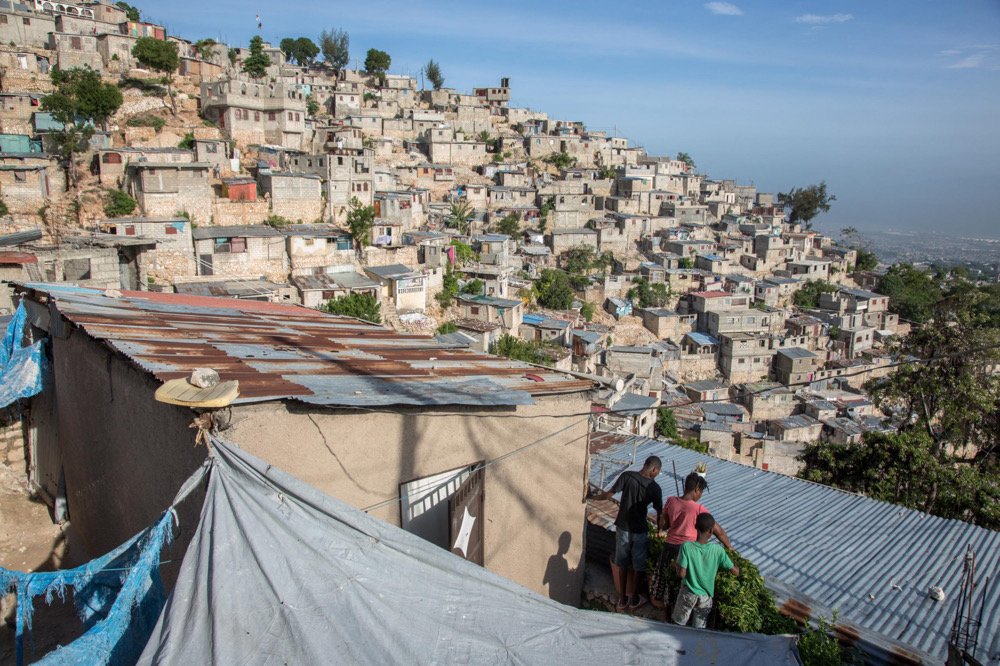
Hunger in an economy that imports food at exorbitant prices, nakedness in an environment saturated with used clothing (pèpè) and the housing destitution of a country built on architectural chaos paint the picture of Haitians living in deprived social spaces, lacking civic and moral norms.
The absence of industries producing consumer goods breeds an obsession with distinction and a need for precedence that drive the poor into unhealthy envy. This identity crisis of the Haitian consumer reveals a social illusion in which eating, dressing and having a home are seen as privileges.
After the epic of Vertières and the payment of an indemnity in gold equivalent today to $21 billion, politics became a contest of performance serving petty appetites. Getting rich through political power has become a habit, deepening poverty and exclusion.
 Transport Package Services
Lacking a vision of community service, Haitian politics has strayed from Aristotle’s ideal of the “homo politikon.” Haitian society has thus developed on the margins of the consumerist conformity of technical modernity.
In the 19th century, in Justin Lhérisson’s work, Madame Boyotte’s behavior is explained by Haiti’s exclusion from the Industrial Revolution. By contrast, that of the innkeeper in Sentaniz belongs to a 20th century marked by 19 years of U.S. occupation.
While Haiti exported raw materials to the United States, it never developed its own industries. Clothing and cars thus remain, in the 21st century, luxury items that breed jealousy and dangerous envy.
In a country without large farms or agri-food industries, supermarkets and fast-food outlets become places of social display. The absence of a true wealthy class grounded in distinction, in Bourdieu’s sense, intensifies this illusory competition.
The market for cheap secondhand goods (pèpè) — “fatra blan fin mete men nou oblije achte pou nou fè chèlbè” (castoffs from abroad that we are forced to buy to show off) — thus becomes a central driver of social rivalry in poor neighborhoods, where lack of culture feeds consumerist illusions.
Cheriscler Evens a étudié la sociologie à la Faculté des sciences humaines de l’Université d’État d’Haïti. Il a collaboré comme journaliste-rédacteur dans plusieurs médias haïtiens. Passionné par l’écriture, il travaille sur des projets littéraires qu’il compte bientôt partager avec le public. Actuellement, il est professeur de communication créole et de sciences sociales au niveau secondaire, et collabore avec le journal en ligne Hebdo 24.
All articlesRead also

Reverend Pastor Amel Lafleur dies at 65
13 Nov

Three Haitian-American Women Elected to School Boards in South Florida’s Largest Counties
7 Nov

Nippes Turns 23: Assad Volcy Calls for Turning the Department’s Heritage and Resources Into Engines of Development
2 Nov

Burkina Faso Adds Haitian History to Its School Curriculum
29 Oct