

What future for Haitian trade and industry amid crisis?
This article is also available in Français and Kreyòl ayisyen
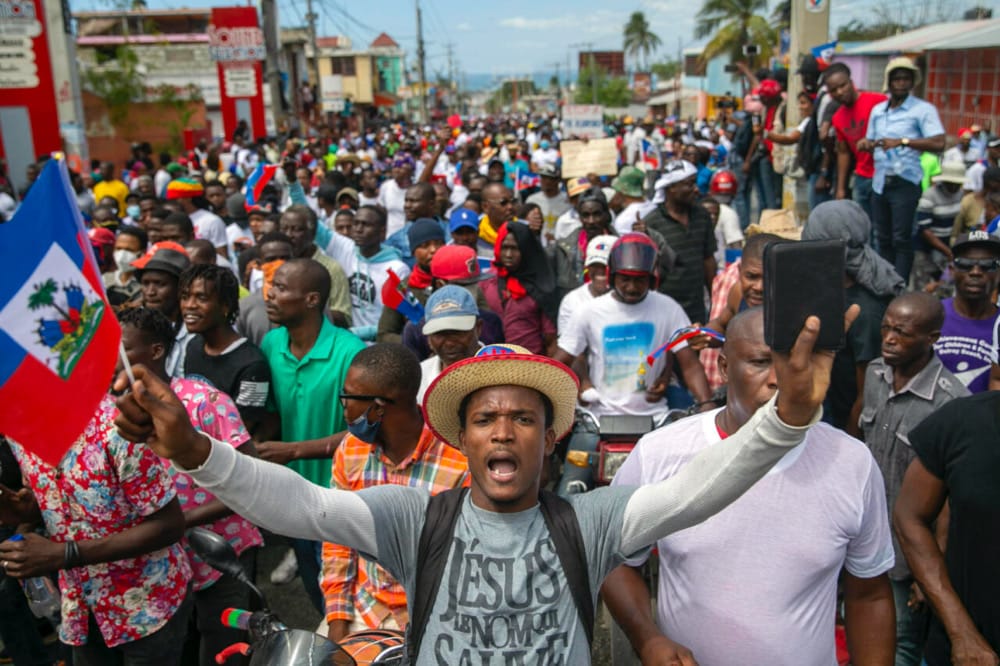
Haiti’s crises as challenges and opportunities
Haiti’s socioeconomic and political crises of the 20th and 21st centuries are not only an expression of the failure of public policy and of foreign diplomacy toward the country. They also represent opportunities to negotiate and promote lasting political and economic solutions.
Historical context
Unlike the crises of the 19th century, which occurred amid the international non-recognition of Haitian independence and the diplomatic stifling of a postcolonial society’s development, the current crisis raises a question: What opportunities are open to stakeholders to discuss and chart paths to recovery for national trade and industry, which have been stifled for decades?
Analysis of the factors behind the economic crisis
Collapse of the national economy
The collapse of the national economy since the fall of the dictatorship in 1957, worsened by the structural adjustment programs imposed by the IMF, the IDB and the WTO on René Préval’s government in 1996, stems from the bottlenecks faced by trade and industry.
- High customs tariffs on exports from an underproductive primary sector widen the trade deficit and weigh on GDP.
- Limiting national industries to subcontracting stifles innovation in the secondary sector.
Aggravating factors
- Corruption weakens institutional controls on imports and tax collection.
- The narrow tax base prevents public financing of local businesses.
- Dependence on international financial aid has become a windfall for successive governments during these decades of structural crisis, punctuated by short-term sociopolitical events.
Aborted initiatives and structural obstacles
Patrick Salomon’s financial policy program
The financial policy program announced by former minister Patrick Salomon (Wilson Laleau’s successor) was never implemented because of the governance crisis linked to disputed elections. The plan called for:
- A monetary policy coordinated with the central bank to strengthen the gourde against dollar inflation.
- Regulation of the informal market, responsible for tax evasion that deprives the state of revenue.
- Financial support for national industry and SMEs, in partnership with the Ministry of Commerce and Industry.
The university chair in trade and industry
The creation of a university chair in trade and industry at the State University of Haiti (UEH) by Rector Fritz Deshommes was supposed to reorient public policy. However:
- The initiative only fed the hope of co-opting young professionals seeking to join the ministerial bureaucracy.
- Crucial issues — entrepreneurship, the informal market, unfair competition from exported products, obstacles to national production, industrial stagnation — were not the subject of operational research by students, who were supposed to inform the ministry, which lacks the expertise to design stimulating policies.
Current challenges and major obstacles
Control by armed groups
What use, however, is this training chair if the Ministry of Commerce and Industry is held hostage by armed groups controlling the administrative center and industrial zones of Port-au-Prince and the West?
Influence of the Syrian-Lebanese mafia
How can new policies be implemented in a ministry subjugated by the Syrian-Lebanese mafia of the import trade? By sponsoring armed groups in the Artibonite, the Cul-de-Sac plain, Kenscoff and Arcahaie, it is stifling:
- National agricultural production.
- Small local industry.
These questions call on the media, economics and development experts, public security strategists, entrepreneurs and international partners to discuss and make radical decisions.
The goal is to break with:
- Smuggling, fraud and tax evasion.
- Corporate corruption.
- The criminal economy (arms and drug trafficking) that feeds economic and political banditry.
Toward a synergy for recovery
Whatever piecemeal measures the current or future minister of commerce and industry may take, saving the economy through a recovery of national trade and industry will have to be the result of a synergy among all sectors aware of the structural dimension of Haiti’s crisis.
Cheriscler Evens a étudié la sociologie à la Faculté des sciences humaines de l’Université d’État d’Haïti. Il a collaboré comme journaliste-rédacteur dans plusieurs médias haïtiens. Passionné par l’écriture, il travaille sur des projets littéraires qu’il compte bientôt partager avec le public. Actuellement, il est professeur de communication créole et de sciences sociales au niveau secondaire, et collabore avec le journal en ligne Hebdo 24.
All articles Transport Package Services
Read also

International Cooperation: Minister Sandra Paulemon Seeks Stronger Coordination of Development Aid in Haiti
5 Nov
Customs Collects a Record 11.5 Billion Gourdes in October Despite Plunging Fuel Revenue
3 Nov

American Airlines Resumes Daily Miami–Cap-Haïtien Flights With an All-Haitian Crew
2 Nov

Minister Sandra Paulemon and UNDP Step Up Dialogue on 2026-2027 Development Priorities
28 Oct