

Endless transition in Haiti: the chaos industry
This article is also available in Français, Español and Kreyòl ayisyen
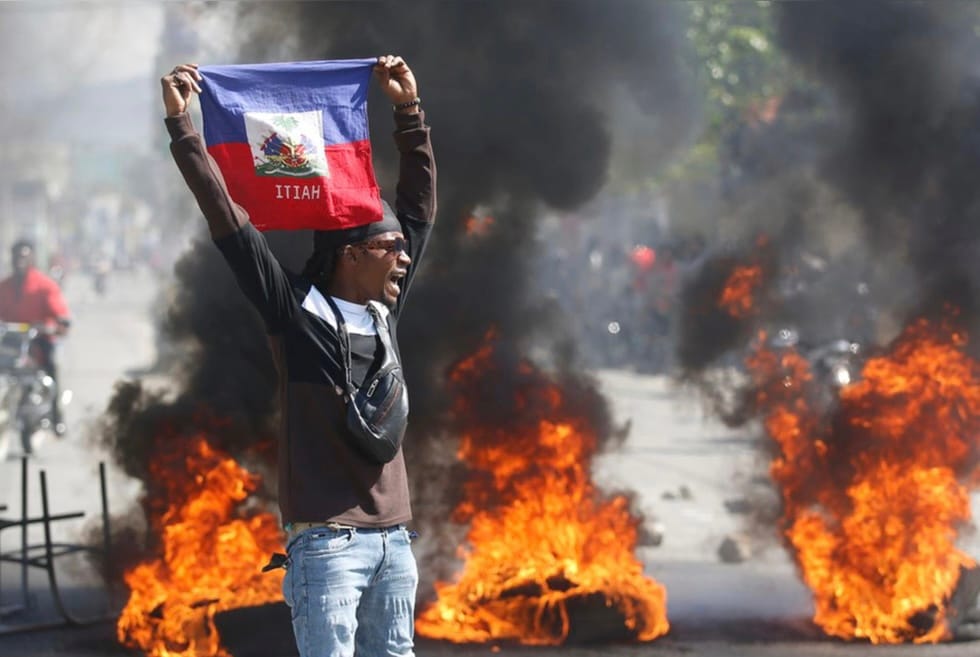
Since the reprehensible assassination of President Jovenel Moïse, the country has been through a transition that keeps renewing itself and changing its players. What should have been a short-term institutional process — ensuring the passage from a contested political situation to one reconciling the conflicting interests of the players and those of the Haitian people — has become an endless transition marked by permanent failure.
Why does what all of society fears persist? Who benefits?
A history of chaotic transitions
Former Presidents Jean-Bertrand Aristide, René Préval and Jovenel Moïse repeatedly urged the oppositions that fought them to accept that political renewal through democratic elections must always be the path to political stability in Haiti. They all feared a transition that would plunge the country into chaos.
Indeed, after President Jean-Bertrand Aristide’s departure in February 2004, the country went through a painful transition marked by Operation Baghdad and its consequences, under the transitional government of former Prime Minister Gérard Latortue.
The end of President René Préval’s term was marked by a prolonged electoral crisis, followed by the Michel Joseph Martelly–Jocelerme Privert succession, until the 2016 and 2017 elections, from which Jovenel Moïse emerged as president, becoming the most contested candidate in the history of Haiti’s presidency.
He even dared tell his opponents that he would be the last president of transitions, which have always cost the Haitian state fortunes and enriched the players in these political mechanisms, often revealed as dishonest governance practices.
The transition: a lucrative political market
His assassination gave his opponents the opportunity to announce a new political transition, which is now proving unable to produce results but is making fortunes for the players who replace one another as the transition’s deadlines approach, a transition that has become endless.
 Transport Package Services
This shows that transitions in Haiti are a mode of governance concealing a logic of political profiteering. Former President Jovenel Moïse, assassinated for refusing to give up power even though his term had ended under the 2016 electoral agreements, feared a transition and denounced the loss of public financial resources the mechanism caused.
However, the state apparatus seems to remain an industry of economic gain, as shown by the history of Haitian politics marked by corruption and political compensation, formal or informal, throughout the 19th and 20th centuries.
A lack of conviction and political responsibility
Without showing any real political will or sense of state authority, the players in the transition are unable to demonstrate an ethic of conviction and responsibility.
That means acting to convince the governed of their will to solve the political problem through decisions that produce concrete and effective results: pacifying territories held hostage by armed groups, putting in place reliable democratic electoral mechanisms for renewal and stability of Haitian democracy, and designing and implementing public policies that favor an inclusive economy for the populations most vulnerable to forms of political corruption.
Then, justifying themselves through moral acts that prove their political and ideological convictions, for example by giving up the state’s economic privileges during the transition (expenses, salaries) and resigning in the face of the failure of their actions.
A will to power without honor
But clinging to political power despite the repeated failures of their decisions seems to be their only political will, reflecting instead a Machiavellian spirit in the politician: keeping power by any means, even dishonorable and dishonest ones.
That is why this endless transition can only lead to permanent political failure, worsening a historic crisis of some 30 years of troubled transfers of political power.
Cheriscler Evens a étudié la sociologie à la Faculté des sciences humaines de l’Université d’État d’Haïti. Il a collaboré comme journaliste-rédacteur dans plusieurs médias haïtiens. Passionné par l’écriture, il travaille sur des projets littéraires qu’il compte bientôt partager avec le public. Actuellement, il est professeur de communication créole et de sciences sociales au niveau secondaire, et collabore avec le journal en ligne Hebdo 24.
All articlesRead also
Erik Prince: Zero Results, One Year After a $52 Million Contract With the Haitian Government
27 Aug
Haiti: Decline as a Strategy for Power
20 Aug
Armored Vehicle Torched, Officers Wounded in Kenscoff… Meanwhile, Vladimir Paraison Puts On a Show
8 Aug
When Foreign Diplomats Become Haiti’s “Instant Experts”
4 Aug